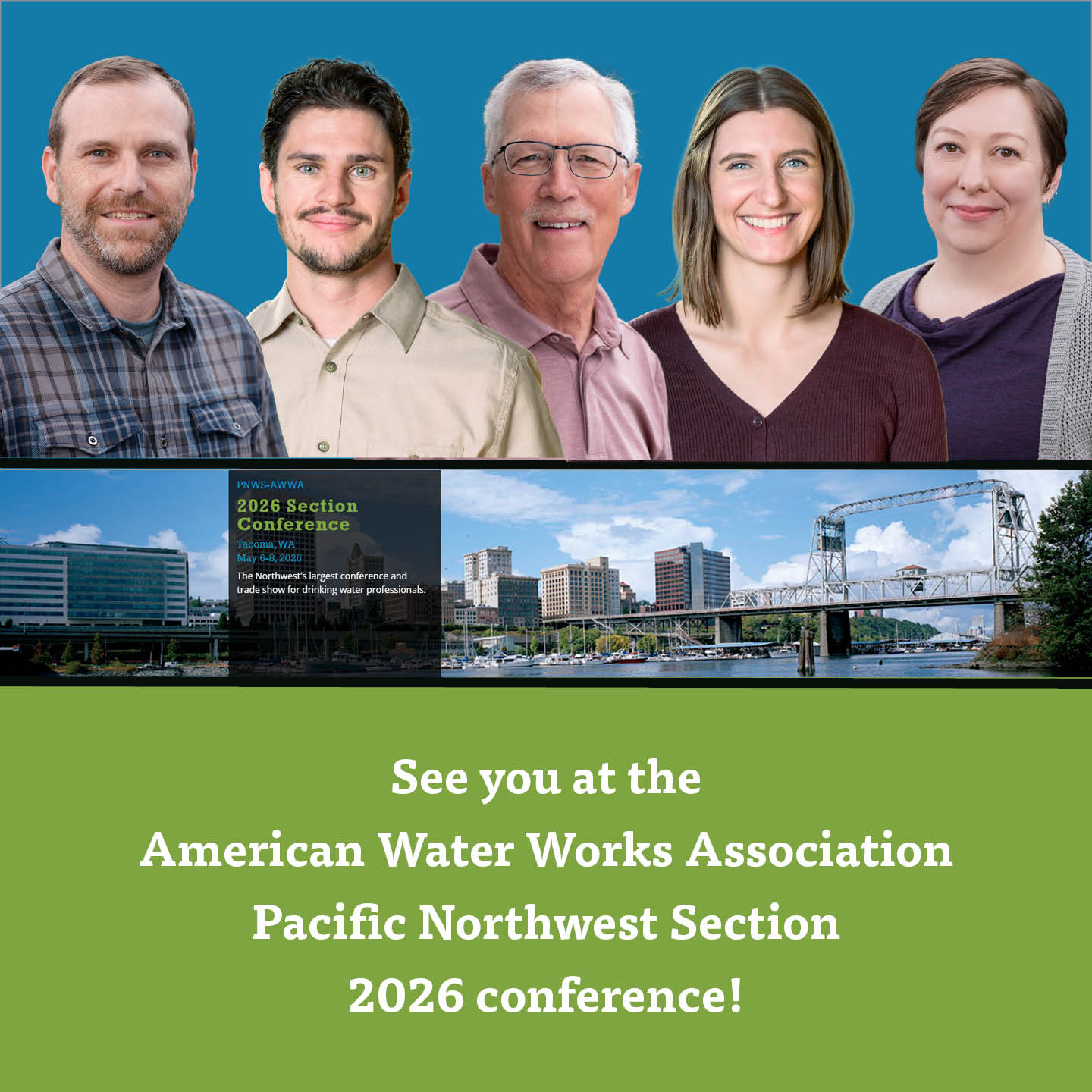
We’re excited to join water industry partners, leaders, utilities, and municipalities at the American Water Works Association Pacific Northwest Section (PNWS-AWWA) 2026 conference, the region’s largest gathering of drinking water professionals, on May 6 to 8, 2026 in Tacoma, Washington. DeEtta Fosbury, RG, will co-present “Impacts of Siting Water Infrastructure in Flood-Prone Areas, A Case Study of the Willamette Valley System” and “Accelerated Delivery for New Groundwater Supply” with our teaming partner, Carollo Engineers. Jason Melady, RG, CWRE, will present “Differentiating Aquifer Storage and Recovery Regulatory Systems in the Pacific Northwest.”
Impacts of Siting Water Infrastructure in Flood-Prone Areas, A Case Study of the Willamette Valley System
Corey Kipp, PE; DeEtta Fosbury, RG
Critical water infrastructure that has successfully served communities for centuries is becoming a liability across the United States due to recent history’s once in a lifetime flood events becoming today’s common events due to changes occurring on our planet. Siting of water infrastructure in flood-prone areas can have severe consequences, both understood and unintended. This presentation will summarize considerations for siting water infrastructure in a flood-prone area, discuss mitigation measures against flood events, and evaluate case studies of floodplain siting consequences in the Willamette Valley System.
Accelerated Delivery for New Groundwater Supply
Co-Presenters: DeEtta Fosbury, RG; Corey Kipp, PE
When faced with a threat to its surface water source, a Willamette Valley water provider undertook a project to increase groundwater capacity in less than two years, from concept to operation. This presentation will discuss the key decisions, risks, and workflows associated with accelerated project delivery by the consultant team.
Differentiating Aquifer Storage and Recovery Regulatory Systems in the Pacific Northwest
Presenter: Jason Melady, RG, CWRE. Co-authored by Nicholas Rudolph, GIT Aquifer storage and recovery (ASR) is a water management technique implemented around the world and is increasingly being utilized across the Pacific Northwest (PNW) for seasonal water storage. The number of ASR projects is expected to grow across the PNW as a result of the impacts of climate change, with increasing temperatures predicted to reduce annual snowpack, which provides a significant source of natural water storage. Environmental challenges of developing surface water storage make traditional surface water storage projects cost prohibitive and impractical in many cases. In contrast, ASR can be cost effective tool for water providers to effectively increase their systems redundancy and ensure emergency preparedness. ASR experts from OR, WA, and ID, will present information about regulatory systems related to groundwater storage to highlight the differences, similarities and complexities that can be a challenge in implementing these kinds of projects.